
Active directory
Cybersolve Active
Directory Identity Assessment
To protect access to enterprise-level apps, you need directory services.
At CyberSolve, we assist clients in building robust directory services that
align with business needs, creating a robust system. Contact CyberSolve
experts to set up Active Directory Management in your organization.

Active Directory
Identity Assessment
Your Active Directory setup is a crucial and continuously
evolving part of your IT system. Given the frequent shifts in
business needs, conducting regular security assessments
and reviews for your Active Directory and its essential
services is now more vital than ever.
Problems Enterprises Face?
A high number of users in
privileged groups
Unconstrained Kerberos
delegation
Poor password and
authentication practices
Service accounts with
elevated privileges
Users having rights to add
computers to a domain

How We Solve Problems?
CyberSolve's Active Directory Identity Assessment Process: Ensuring Robust
Security through Methodical Steps
Comprehensive IAM Policy and Standard Review
Our process begins with a thorough evaluation of your organization's Identity and Access Management (IAM) policies and standards specific to Microsoft Active Directory. We meticulously assess the current state, considering the nature of your business and organizational maturity.
Proactive Account Inactivity Policy Implementation
CyberSolve implements an Account Inactivity Policy that ensures heightened security. We recommend disabling and subsequently deleting accounts that remain inactive for a specified period, typically following a 90-day rule but never exceeding 180 days.
Strengthening Password Policies for Robust Defense
We enforce strong password policies to fortify your AD security. CyberSolve mandates passwords to be at least 12 characters long, incorporating a dynamic mix of upper and lower-case letters, numbers, and special characters.
Standardized Account Naming Conventions for Consistency
Our approach involves establishing standardized account naming conventions to bring consistency to user identities. This includes employing formats such as "mukul.bisht" or "mbisht" while considering the addition of a random number for increased security.
Clear Naming Conventions for Privileged Accounts
CyberSolve defines explicit naming conventions for privileged accounts to easily identify non-standard roles. Utilizing identifiers like "a," we structure names such as "m.bisht3468" for local administrator accounts.
Innovative Just-In-Time Administration Implementation
We recommend adopting Just-In-Time (JIT) Administration, leveraging Active Directory customization or equivalent Privileged Access Management systems. This approach grants temporary permissions for privileged tasks, ensuring adherence to the principle of least privilege
Restricting Standard Account Authority
CyberSolve advocates for limiting standard account authority, ensuring that regular user accounts are devoid of any administrative privileges, whether on an individual basis or as part of privileged groups.
Purposeful Naming Conventions for OUs and AD Groups
Our process involves establishing clear and purposeful naming conventions for Organizational Units (OUs) and AD groups. OUs can be structured departmentally or geographically, while groups are named based on their security roles.
Inclusive Patching Policy for AD Infrastructure
We integrate a comprehensive patching policy that explicitly includes the Active Directory infrastructure, with a particular focus on Domain Controllers. CyberSolve ensures that patching reports are regularly provided to IT and InfoSec management, maintaining a monthly reporting cadence.
Why is our Approach Better
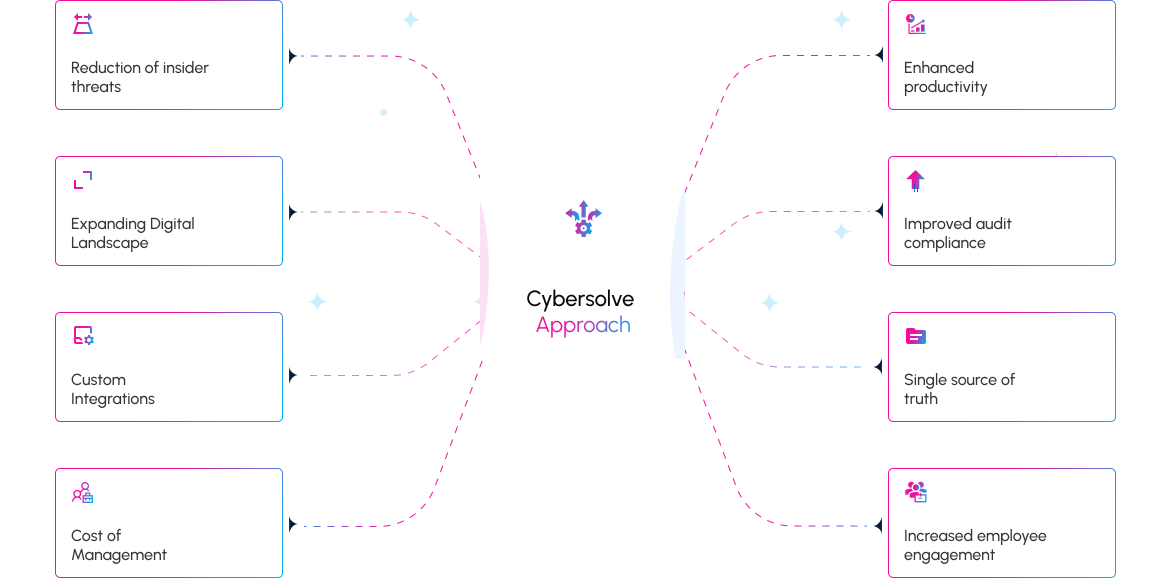
Key Outcomes
Ensuring the organization is spending its time and resources in the best way.
The exercise of building the roadmap paves the way for a smooth implementation.
Reveal gaps in the implementation plan so that they can be addressed before they become a problem.
Decision makers can clearly see the tradeoffs and choices available to meet the organization’s objectives.
Identifying common capabilities that can be leveraged and/or opportunities to share development costs.
Ensuring better outcomes by tying the project to key business drivers.
Builds a common understanding of the plan and a sense of shared ownership, as it will incorporate the opportunities and insights from the broader team.
Roadmap can communicate the plan to different stakeholders so that they can, in turn, use the information in their own planning, as well as providing their guidance and input
